

 Review by Ryan Crawford/model photos by Tony Cook
In late 2025, ScaleTrains began shipping its latest HO scale Rivet Counter run of Electro-Motive Division’s (EMD) SD38-2 diesel locomotives. Offering of this uncommon EMD six-axle prototype is not surprising in today’s marketplace, especially with the components on hand from ScaleTrains’ popular Rivet Counter EMD SD40-2. Utilizing the company’s SD40-2 platform, this Dash 2 model would be a natural for the Tennessee-based company. The two prototypes (SD40-2 and SD38-2) share the same 68 foot 10-inch frame. The difference in the two is not size, but applicable horsepower by way of EMD’s popular 16-cylinder, 645E diesel prime mover. The SD40-2 utilizes a turbocharger, netting 3,000 hp, while the SD38-2 uses the same engine block, but is fed via a set of superchargers (what diesel historians label “normally aspirated”) that puts out 2,000 hp.
The easiest way to explain the creation of EMD’s SD38-2 is to place a GP38-2 car body on top of an SD40-2 chassis; in essence, that is what you have with this locomotive. The detail differences between the SD40-2 and SD38-2 are the number of radiator fans (two for the 38 and three for the 40) and size of the radiator intake screens. The SD40-2, being turbocharged, has a single exhaust outlet, whereas the SD38-2 possesses two exhaust outlets. The idea behind this combination of two similar locomotive models yields a unit that can move heavy tonnage (six axles equal improved tractive effort), and the removal of the turbocharged motor that is not needed for heavy drag applications.
The SD38-2 became popular with roads that hauled heavy unit trains, such as central Illinois coal-hauler Chicago & Illinois Midland (C&IM), and iron ore roads such as Duluth, Missabe & Iron Range. EMD marketed its SD38-2 as an excellent locomotive for hump yard applications. This Rivet Counter SD38-2 production includes examples covering those users well. ScaleTrains does exhaustive research of prototypes and always offers good execution with prototype-specific and railroad-specific details for its Rivet Counter HO-scale diesel locomotives. This review will focus on one of the six C&IM SD38-2 prototypes offered by ScaleTrains.
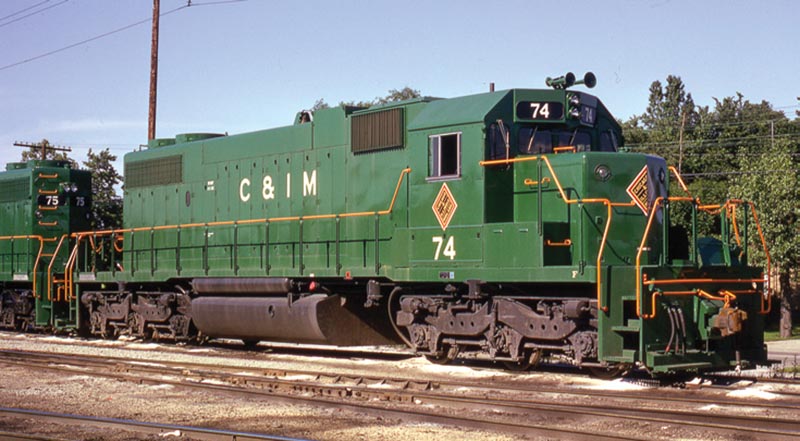
ABOVE: Above: On June 2, 1974, just weeks after delivery, C&IM 74 is coupled to 75 at Springfield, Ill. This is exactly how the units were painted when delivered in May 1974. Notice the railroad has yet to install the all-weather cab window, orange trim on the step edges, and the rear diamond decal (look at unit 75 in background). Within a year, the orange trim would be added, as were the cab windows and the diamond decal on the rear hood. Good attention to detail on the ScaleTrains Rivet Counter replica is the three sets of instructions on the hood door in white. —Richard R. Wallin photo, Ryan Crawford collection
C&IM Motive Power History
Owned by Commonwealth Edison (CWE) for more than 80 years, Chicago & Illinois Midland had one job: hauling coal to feed the hungry boilers of CWE’s power plants in the Chicago area. The locations included a massive power plant located at Powerton, Ill., just south of Pekin. Since 1926, the modern C&IM, stretched 121 miles across Illinois from Taylorville to Pekin. At a location known as CIMIC (named for the two railroads, C&IM and Illinois Central, that met at this location), C&IM utilized 16 miles of trackage rights on Illinois Central to reach Springfield, Ill. Springfield became the railroad’s headquarters in 1956. Up until the mid-1950s, coal hauling duties were entrusted to an expertly maintained roster of 0-8-0, 2-8-2, and 2-10-2 steamers.
When it was time to dieselize, C&IM manage-ment turned to EMD, which surveyed the railroad and proposed that 11 diesels could do the work of 21 active steam locomotives. In April and May 1955, two EMD SW1200s, 18 and 19, were purchased and went to work. By November 1955, C&IM added four additional SW1200s (20–23) and five rugged SD9s (50–54) to handle the tonnage on C&IM’s route. During the early dieselization phase, coal was picked up from Peabody Mine No. 10, located at a recently constructed coal handling yard known as Ellis, four miles east of Pawnee, Ill. This segment of the railroad ran east and west and was named the Taylorville Division, running from Taylorville to CIMIC. Coal trains were hauled northward through Springfield and on to Havana, the location of a modern coal dumping operation on the Illinois River, known as the Havana Coal Transfer Plant, and it was here that coal trains were emptied by a Wellman rotary car dumper and transloaded into awaiting barges. The barges would handle the coal upriver to the many small CWE plants in the Chicago area. Coal from mine No. 10 and coal received from connecting railroads was also way-billed to CWE’s Powerton Generating Station south of Pekin. By 1960, the little C&IM was bursting at the seams with coal business; and those 11 EMD diesels handled the tonnage.
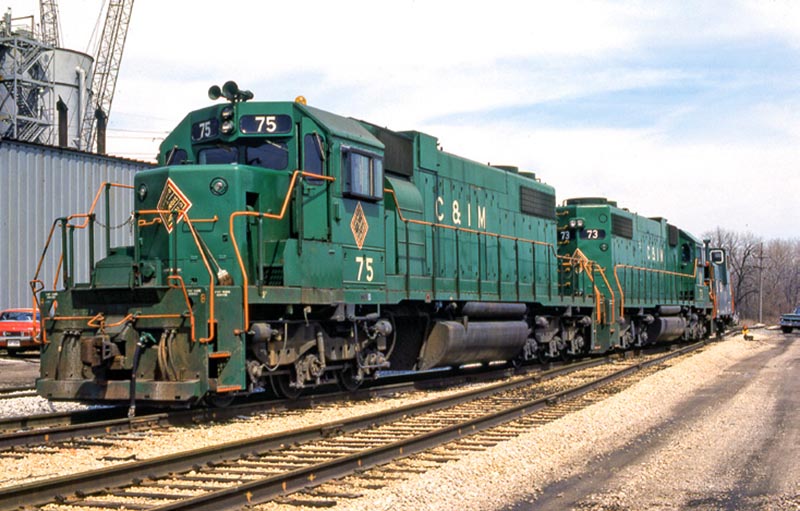
ABOVE: This photo of C&IM 75 and 73 at Powerton, Ill., on March 29, 1978, matches well with ScaleTrains’ HO scale Rivet Counter SD38-2 models. Footboards are gone from the pilot, a beacon has been installed on the roof, all-weather windows appear on the cab, and upturn extensions are welded to the coupler cut levers. Trailing unit 73 clearly shows it retains the diamond herald on its rear hood. Unit 75 retained part of its original hose holders on the pilot, but those will be removed in a few years, which is exactly how the ScaleTrains replica is detailed. —Robert Farkas photo, Ryan Crawford collection
As coal volumes remained steady, management decided to purchase additional locomotives. In Septem-ber and October 1960, the railroad received the only two RS1325 road switchers EMD built (30–31). These four-axle, half-breed switcher/road units would be among the rarest diesels ever to come out of EMD’s plant, and their rarity brought flocks of railfans from all over the world. Unfortunately, the RS1325’s small size, and low horsepower, would not fill the bill for heavy-tonnage coal trains. They were simply not suitable for a coal hauling railroad. Realizing this, C&IM management went back to EMD for help. In 1961 and 1962, the railroad took delivery of a pair of six-axle 1,800-hp, SD18s (60–61). This was a great investment for C&IM as coal tonnage began to really blossom through the mid-1960s. Unfortunately, in 1967 the railroad withered for lack of business due to CWE’s decision to build a new power plant at Kincaid, just across the highway from the already active Peabody Mine No. 10. When this operation began, C&IM’s tonnage was drastically cut, and storm clouds loomed on the horizon.
In 1970, a dramatic change of events unfolded which would forever change C&IM. Commonwealth Edison was in the midst of complying with Clean Air Act legislation and began purchasing low-sulfur coal from newly opened Western U.S. mines located in Wyoming and Montana. This changed the routing of coal southward on the C&IM instead of northward. With this massive influx of Western coal, now interchanged with Chicago & North Western and Burlington Northern in East Peoria, C&IM’s diesel fleet was stretched to the absolute max. The railroad was faced with a decision on purchasing new diesels to meet these new tonnage demands. C&IM purchased six 2,000-hp SD38-2s (70–75) from EMD in May 1974. This wise decision would have positive implications for the next 22 years of the railroad’s existence.
C&IM’s EMD SD38-2s
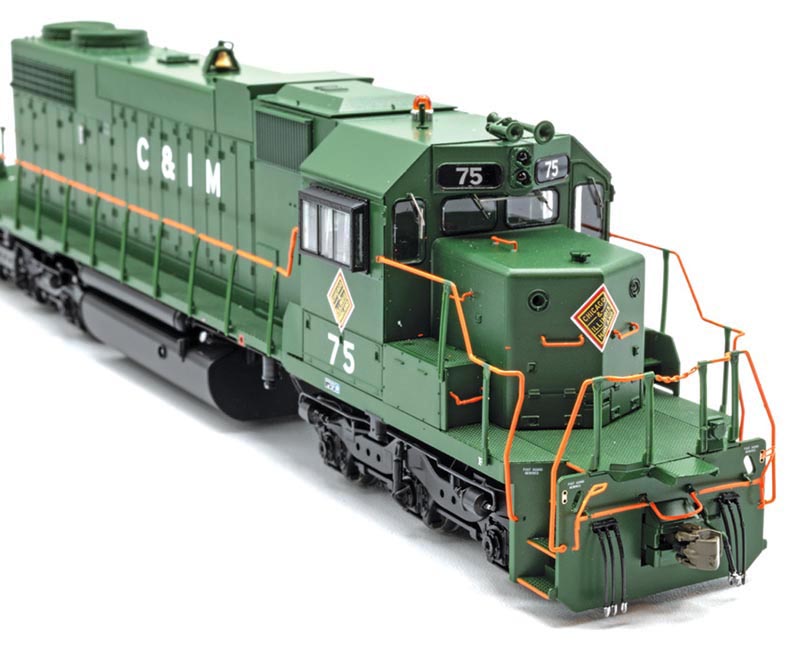
Chicago & Illinois Midland began receiving these newest and most powerful on the roster diesels in May 1974, arriving on property from May 9 through May 29th. ScaleTrains’ review model C&IM 75, was received at Springfield Shops from an Illinois Central Gulf transfer at 1:30 P.M. on May 29, 1974. Surprisingly, the fleet lacked the traditional red band with white pin stripes worn by all other diesels on the roster. The SD38-2s were outfitted with similar features: 3,200-gallon fuel tank, no dynamic brakes, 81-inch low nose with ratchet-style handbrake, flush-mounted exhaust stacks, and dual cab controls.
When delivered, they lacked the rear company diamond decal, radio antenna, and three-pane all-weather windows. These were added by the railroad shortly after arrival. Ironically, the brass bell and unique, top of hood bracket was not installed by EMD; but instead, were placed on the front porch of the locomotives during transit and installed by C&IM shop forces at Springfield. The paint scheme was a basic green dip job with black trucks and black jacking pads. They had 18-inch C&IM hood initials on the car body and 14 1/4 inch road numbers painted on the access doors below the cab, all in white. All six units wore the traditional diamond decal on the cab sides and on the front nose when delivered, with the rear decal added after delivery. The units cost $350,000 each, a modest sum by today’s standards, and the railroad paid an extra $75,000 for a spare HTC truck.
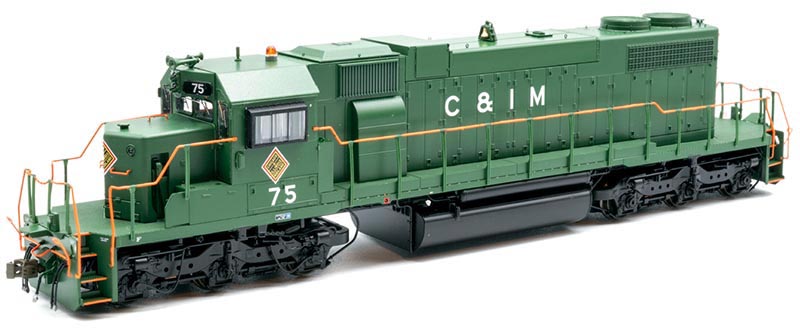
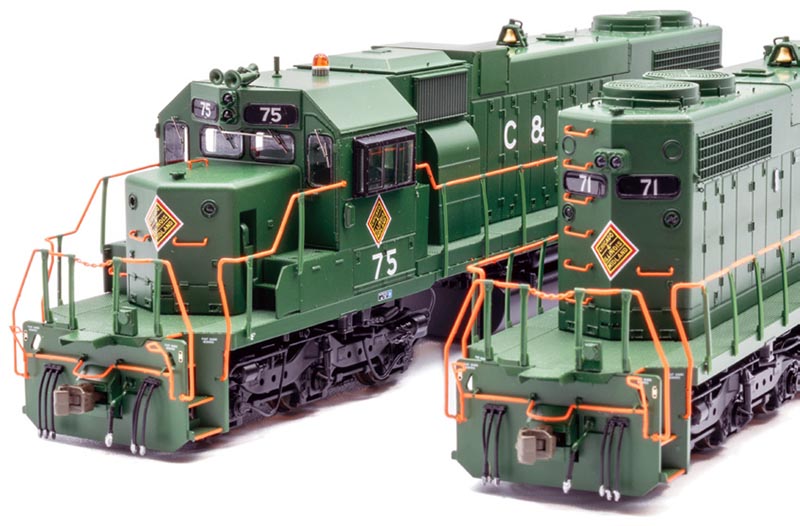
Above: This ScaleTrains Rivet Counter SD38-2 brings several looks and all road numbers for Chicago & Illinois Midland in this production run. This example, C&IM 75, features a look the unit possessed a short time after its delivery in 1974 through much of the rest of the 1970s.
When delivered, the SD38-2s had orange handrails with green stanchions. The orange on the step edges and footboards did not come along for a couple of years. They also displayed orange coupler cut levers on the front and rear pilots. Footboards were present on the pilots, which were eventually outlawed by the FRA in 1978. Around 1977, all C&IM’s road units were fitted with a Commander beacon that was located atop the cab, near the rear cab edge. One interesting detail concerning the placement of the beacon on the SD38-2s was the plate which held the beacon, about eight inches above the cab roof. This raised plate helped establish better sight lines due in part to the modern EMD angular cab design…
