
 Front and center on Kato’s table at the 2025 N Scale Enthusiast convention this past summer in Overland Park, Kan., was an unpainted pre-production SD70ACu model. A unique model based on the SD9043MAC platform, Canadian Pacific (CP) and Norfolk Southern (NS) are the only ones to roster these behemoth units, so let’s learn more about the largest diesels currently roaming the North American rail network.
The Prototypes
The SD9043MAC was an interesting chapter in the horsepower race, with units delivered rated at 4,300 hp with the option to upgrade to 6,000 hp, although that enhance-ment never arrived. CP’s big 415,000 pound, 80-foot AC traction units were mostly sequestered in a joint pool with Union Pacific (including many of that road’s SD90MACs) on the Spokane International route between Spokane, Wash., and Calgary, Alb., Canada, crossing the border at Eastport, Idaho/Kingsgate, B.C. Riding on HTCR-II trucks with 45″ wheels, the SD90s became victims of their own specialized success, as I recall seeing early UP 8000-class examples on western coal trains across southern Illinois in the late 1990s.
Norfolk Southern and General Motors’ Electro-Motive Division Successor company Progress Rail developed the SD70ACu rebuild concept as an answer to best utilize the barely 20-year-old SD90MACs for upgrade, basing this on the success of the more recent SD70ACe model. The 710G3C prime mover was overhauled, with wear items renewed or replaced, including new isolated cabs and the forward electrical section of the hood, as this was transitioned from older Siemens to newer Mitsubishi products. EMD/Progress Rail competitor Wabtec is leading in the locomotive rebuilding race, converting similar vintage GE products into refreshed units, utilizing C44-9W and AC4400 cores, while also building new ES44 series units.
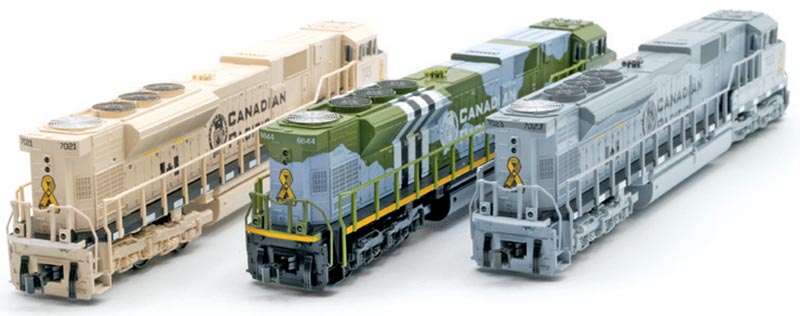
As of this writing, the last of the un-rebuilt Union Pacific and CIT/CEFX SD9043MAC fleet have been dismantled. Norfolk Southern’s roster of 45 units spread across number series 7229–7339 and Canadian Pacific’s fleet of 60 units (7000–7059) are the upgraded and designated survivors out of nearly 375 SD9043MACs built from 1995–1999. The roster lineage on these units is tough to trace, as they were leased or sold in batches from Union Pacific to both Norfolk Southern and CP directly for their respective rebuild programs, or back through Progress Rail. The CP rebuilds wander all over North America, while Norfolk Southern’s fleet is generally kept in captive pusher service between Conway and Altoona, Pa. over the famous Horseshoe Curve. CP 6644 and 7020–7023 were rebuilt at Progress Rail’s Mayfield, Ky., facility in 2019, and were observed in transit on BNSF at Centralia, Ill. with wrapped exteriors hiding the bodies — the only clue something was afoot would be the uniquely coordinated truck colors that were visible during transit.
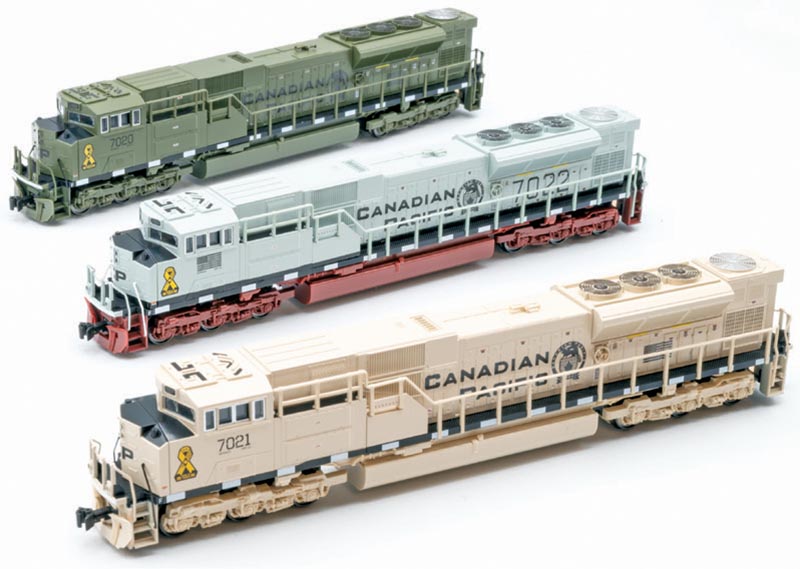
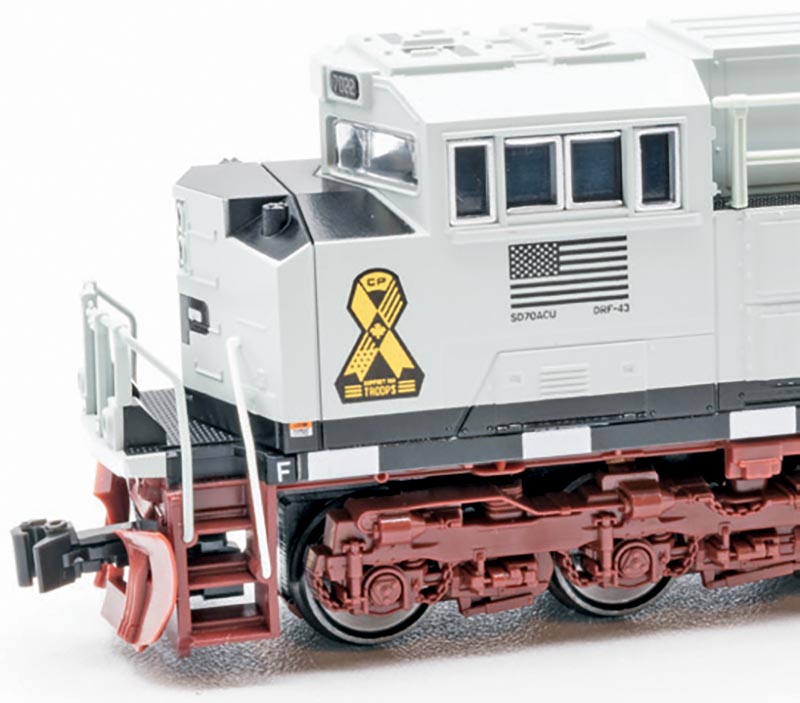
Let’s take a look at each of these unit’s past, cores, and schemes, as they are a trip through both countries’ military, naval, and navigational history. All units have CP’s “Support Our Troops” yellow ribbon on the nose, and four of the five have U.S. flags on the conductor’s side of the locomotive and the Canadian flag on the other (illustrating CP employs both active duty and veterans from both countries). Unveiled in a stunning lineup at CP’s Ogden Shops in Calgary, Alberta, on November 11, 2019, these units can be found working all over the expanded CPKC system, and have ventured offline, on occasion, in run-through service.
CP SD70ACu 6644, built as CP 9160 in May 1999 (serial/frame number 976842-61), wears a specially considered and designed scheme based on the Royal Canadian Air Force “Spitfire” fighter planes flown at the Allied invasion of Normandy, France, on June 6, 1944. This one is probably the most stand out with green/gray camouflage and the white/black tail stripes across the radiator section.
CP SD70ACu 7020 was built as CP 9113 in November 1998 (serial/frame number 976842-14) with North Atlantic Treaty Organization (NATO) green applied, as seen on equipment deployed in temperate regions.
CP SD70ACu 7021 was built as CP 9107 in November 1998 (serial/frame number 976842-8), and wears an arid climate sand color, used by Canadian and American application to army vehicles and equipment.
CP SD70ACu 7022 was built as CP 9146 in April 1999 (serial/frame number 976842-47). It is painted in the “battleship” gray, black, and oxide red scheme of modern North American warships, with large road numbers under the radiator section.
CP SD70ACu 7023 was built as CP 9128 in December 1998 (serial/frame number 976842-29), and is painted in a two-tone gray Air Force scheme that is similar to what is applied on U.S. and Canadian fighter jets…