

 Review by Clem Harris/photos by Tony Cook
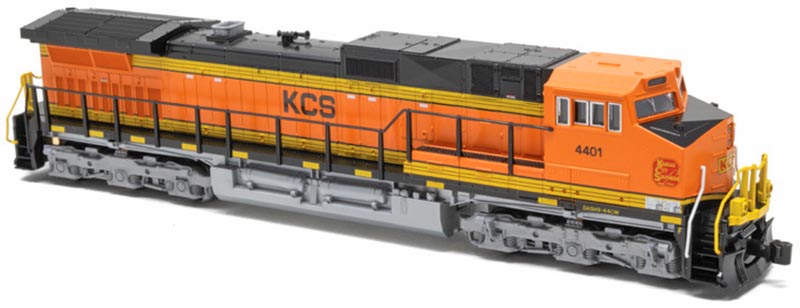
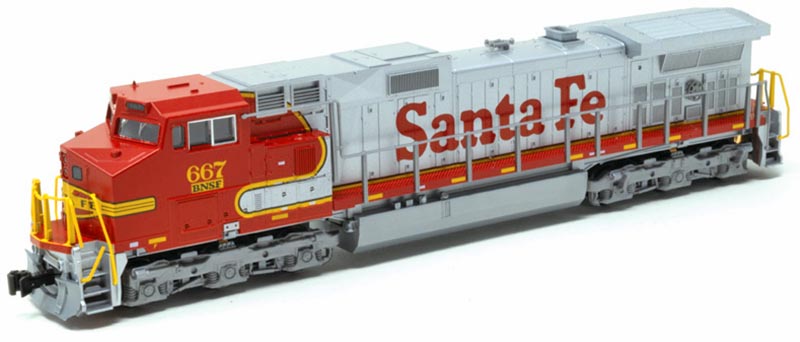
Kato recently released a group of C44-9W diesel locomotive models in N scale. This collection includes several BNSF Railway looks. I’m sharing an orange BNSF painted C44 that includes patching for second owner Kansas City Southern (KCS). I also review a SuperFleet livery decoration with patching for BNSF ownership.
Prototype Profile
BNSF 667 was originally built as Santa Fe 667 in August 1994, as part of a 100-unit C44-9 order. These six-axle locomotives, delivered in iconic SuperFleet livery, invoked memories of a rich history of passenger trains racing across the American Southwest. The SuperFleet paint scheme was introduced in 1989 by Mike Haverty, Santa Fe’s president. In an August 1989 Chicago Tribune article, Haverty stated, “I think that restoring the Warbonnet is a way to demonstrate to our customers and the industry that we deliver quality transportation. At the same time, the Warbonnet will give our employees a sense of pride in their heritage. We’re in some tough times now. Competition is tough. There is an overcapacity of all transportation. So only the fittest will survive; those that are innovators and aggressive. And we will.”
As Santa Fe purchased locomotives after 1989, they were delivered in this new version of the famous red and silver, which many associate with the last few years of the Santa Fe and their priority intermodal service with J.B. Hunt. Santa Fe merged with Burlington Northern to become the Burlington Northern Santa Fe Railway in 1995. Santa Fe’s and BN’s combined purchases of General Electric’s (GE) C44-9W model totalled around 1,700 units between 1994 and 2005.
Based on pictorial evidence, sometime around 2005, Santa Fe 667 became BNSF 667 with the addition of lettering under the road number on the cab showing BNSF ownership, as KATO has reproduced for this release.
Kansas City Southern and its Mexican subsidiaries purchased 125 AC4400CW units, which are the AC traction motor cousin of GE’s C44-9W. KCS chose not to purchase the DC traction motor C44-9W, though the railroad would eventually roster this model.
KCS 4401 was built as BNSF 4799 in June 1998. BNSF 4799 received Heritage III orange and black livery. BNSF 4799 was on a long-term lease via General Electric Capital. When this example and others on lease were returned to General Electric Capital in 2021, several railroads picked up these used C44-9Ws, including Kansas City Southern. These new-to-KCS locomotives were quickly patched out to no longer show BNSF, though they retained that road’s colors. They received block KCS letters on their long hoods and the road’s logo on the sides of the nose and across where the BNSF “cigar band” herald had appeared on the nose. In addition to Kansas City Southern, many of the other leased C44-9W originally painted BNSF were changed to Norfolk Southern.
The Models
Out of the box, I was pleased with Kato’s efforts on both samples. The paint, lettering, and graphics were well rendered, and spot-on in relation to placement on the prototype. Both N-scale locomotive models had the proper version of General Electric’s high-adhesion truck sideframes, matching pictures found during my research.
You’ll notice variations in the handrail style with BNSF 667 possessing the early style, wider hand rail arrangement across the front and back of the locomotive over the pilots. KCS 4401 has the narrow arrangement with the handrails coming inward as the raise up to the outer stanchions over the pilots in front and rear.
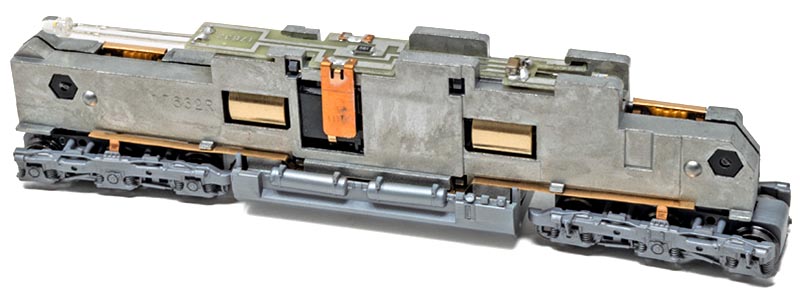
A couple of enhancements worth noting that I was happy to see up-dated on these Kato models was the improved appearance of the fuel tank and ditch lights. Check out the depth and detail on the area between the top of the tank and sill on BNSF 667 above. The ditch lights on the pilot are a better representation versus prior toolings.
These models also feature what I consider to be a nearly indestructible mechanism. I love the design simplic-ity and durability of Kato’s drive. This 1:160 C44-9W locomotive model includes a DCC friendly electronics setup. Options for a drop-in DCC de-coder include Digitrax DN163K1A, ESU 59721 Lok Pilot Train, and Control Systems K1D4 decoders are available if you want digital control and non-sound operation. For sound and DCC capability, ESU’s 58741 decoder is available, and SoundTraxx offers two decoders with sound options for these Kato locomotives.
I chose a break-in for these C44-9Ws, which is the same practice I follow for DCC installs for speed matching. I have the model pulling a homemade track cleaning car that weighs 2.2 ounces and drags a cleaning pad (this single car provides similar resistance of a longer train consist)…